

From a $4 experiment
Early in my career, in 2013, I ran an ad for an event with a 25 EGP ticket. I spent about $4 and sold 70 tickets. Years later, when I compared that experience, reaching the same number required a much bigger budget. It’s a personal comparison between two periods, not a benchmark for ad costs at any given time.
Why do costs go up?
In my view, competition has widened in many sectors, and some advertisers raise their budget every time results are slow, without diagnosing the problem. That makes any weakness in the offer or targeting very expensive.
Before saying “ads got expensive”, separate the metrics
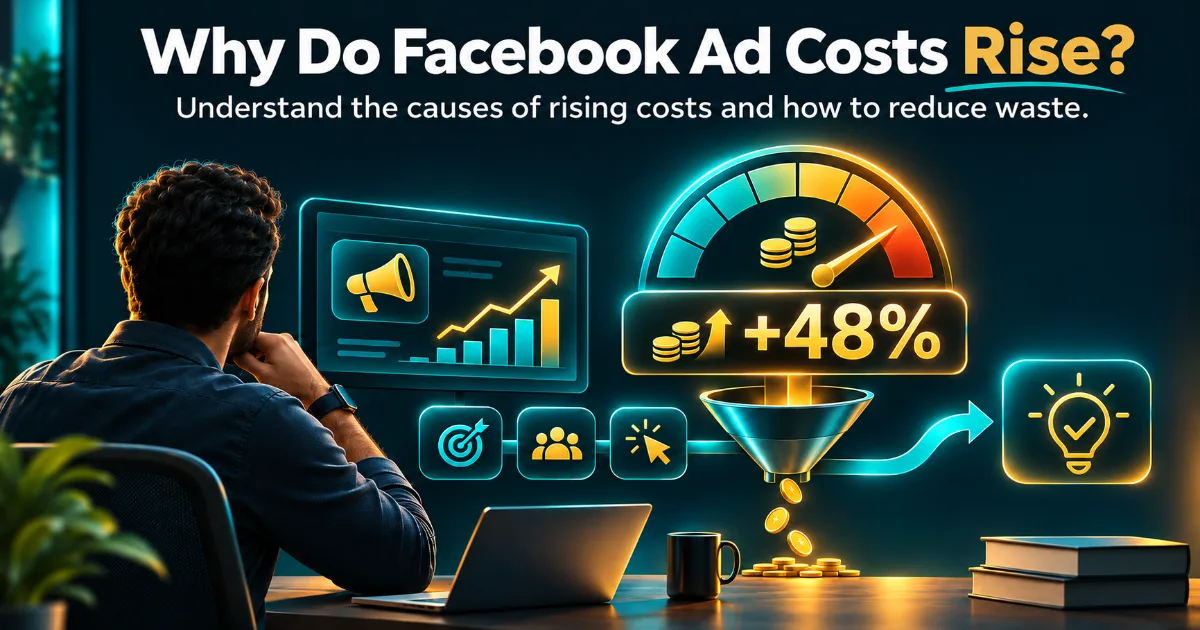
A higher CPM isn’t the same as a higher cost per sale. Track cost per reach, click-through rate, cost per visit, on-page conversion rate, cost per new customer and profit margin. Sometimes the ad price hasn’t changed; the website got slower or replies to customers got late.
A story from a clothing factory
I met the owner of a women’s clothing factory who promoted his products himself from his page. He gradually reached about $150 a day, and every time results were weak, he spent more. The problem wasn’t where he clicked the boost button; it was the lack of a systematic way to measure results.
The fix starts before the ad
Review your profit margin, response speed, landing page or website, the offer itself, and how you follow up with people who asked but didn’t buy. A sales funnel isn’t a buzzword for meetings; it’s a chain of connected steps where each one has to serve the next.
A calculation that matters
If you spend 3,000 EGP and get 100 inquiries, your cost per inquiry is 30 EGP. But if only 10 are qualified, your cost per qualified inquiry is 300 EGP. Measure the step that brings you closer to profit, not the easiest number in the report. The example is hypothetical.
A practical plan to reduce waste
Test one clear offer with several creative angles, improve your page and response time, and connect key events to measurement tools in line with your privacy policy. Don’t raise the budget automatically to fix weak results; understand the cause first. If you compare different periods, account for market changes, prices, seasonality and exchange rates.
Should you stop advertising?
Not necessarily. You can cut waste and improve conversion, change the message, or test an additional channel. The decision should rest on real numbers, not on a feeling that the platform simply got expensive.
The bottom line
Before asking “how much should I increase the budget?”, ask “where is the money leaking in the customer journey?” Sometimes fixing the step after the ad matters more than launching a new one.
Want to apply this with someone reviewing your work?
Hands-on digital marketing training, plus the free Marketing Challenge for a limited number of people.

Khaled Yousef
Marketing consultant, marketing manager and digital marketing lecturer with 12+ years of hands-on experience and 55,000+ trainees.
About Khaled →